
AI voice agent vs traditional IVR, chatbot and receptionist.
Nobody has ever enjoyed pressing 1 for sales. Most businesses answer calls with a phone menu, a small team, or both. Here is IVR vs AI voice agent in plain terms: how the agent actually differs, including where it doesn’t win.
- No signup needed
- 5 free calls
- 130+ languages
IVR, IVA, conversational AI, voice agent: what each one means.
- IVR (interactive voice response)
- A phone menu. It plays recorded options and routes the call based on the key the caller presses, or a few fixed words. It routes; it does not answer questions.
- IVA (intelligent virtual assistant)
- A broad industry term for software that understands natural language and can complete simple tasks, by text or by voice. On a phone line it usually means the same thing as an AI voice agent.
- Conversational AI
- The underlying technology: speech recognition, a language model that works out what the person means, and speech synthesis to reply. Chatbots and voice agents are both built on it.
- AI voice agent
- Conversational AI on a live call. It listens, understands the request, answers from approved information, takes actions such as booking or transferring, and logs the call. Used to replace a menu, it is often called an AI IVR.
- Chatbot
- A text assistant on a website or messaging app. Useful for people who prefer to type; it cannot answer the phone calls your business receives.
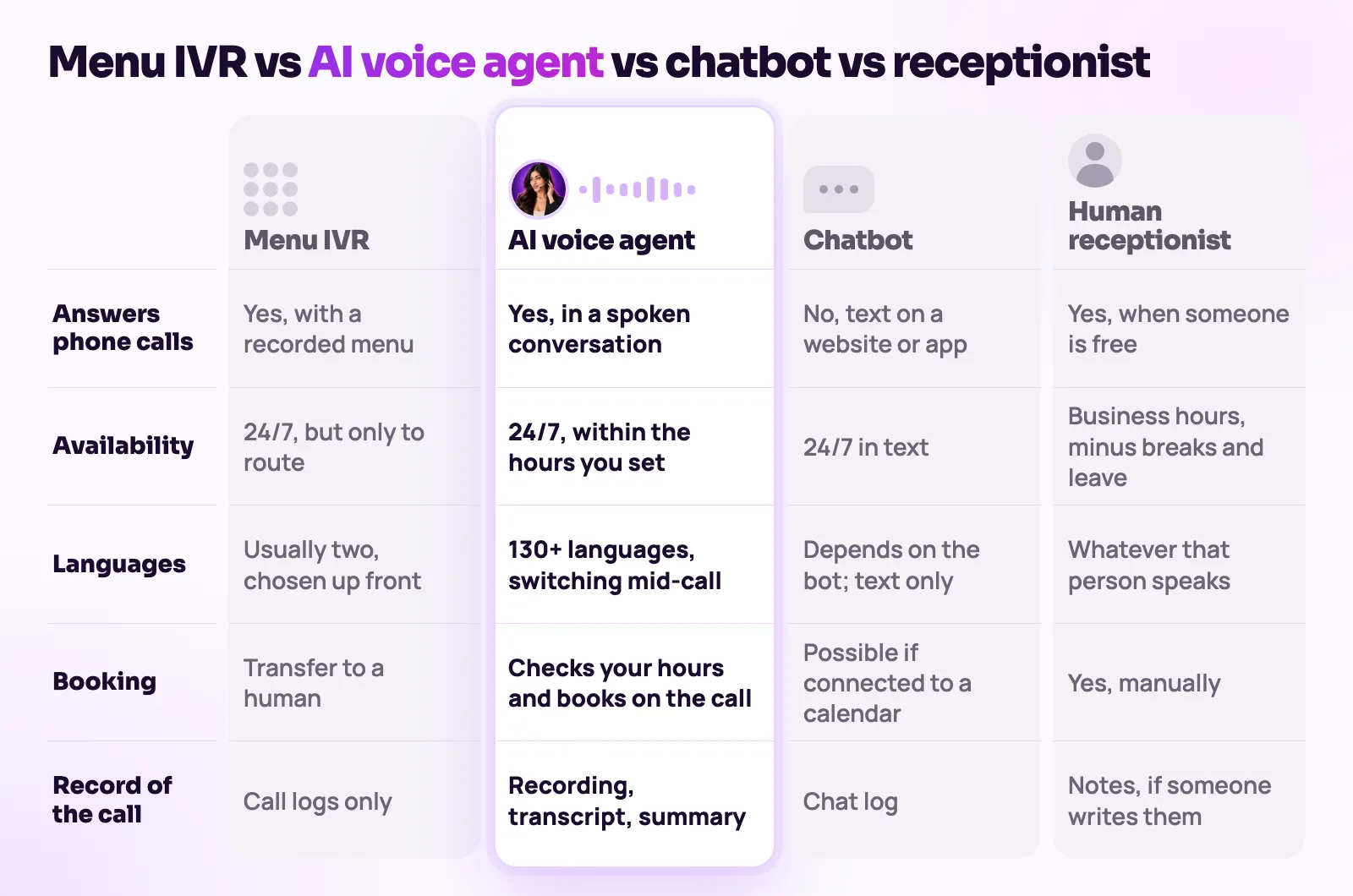
Menu IVR vs AI voice agent vs chatbot vs receptionist.
| Dimension | Traditional IVR | AI voice agent / AI IVR (Vistrow Voice) | Chatbot | Human receptionist |
|---|---|---|---|---|
| Answers phone calls | Yes, with a recorded menu | Yes, in a spoken conversation | No - text on a website or app | Yes, when someone is free |
| Caller experience | Press 1, press 2, press 9 to repeat | Says what they need and gets an answer | Types a question and reads a reply | Natural - if someone picks up |
| Availability | 24/7, but only to route | 24/7, within the hours you set | 24/7 in text | Business hours, minus breaks and leave |
| Languages | Usually two, chosen up front | 130+ languages incl. 10 Indian languages, switching mid-call | Depends on the bot; text only | Whatever that person speaks |
| Peak load | Queues and hold music | Several calls at once, up to the limit you set per number | Many chats at once | Queues, or missed calls |
| Answer quality | Fixed menu, no answers | Grounded in your knowledge base, consistent every call | Depends on its content and setup | Varies by person and by day |
| Booking an appointment | Transfer to a human | Checks your bookable hours and books on the call | Possible if connected to a calendar | Yes, manually |
| Record of the conversation | Call logs only | Recording, transcript, summary and CRM sync | Chat log | Notes, if someone writes them |
| Cost as volume grows | Flat, but unresolved calls pile up | Per minute of conversation, no new hires | Varies by vendor | Linear - more calls, more people |
It depends on the calls you get.

A menu IVR is enough when…
Calls only need routing to two or three departments, every caller speaks the same language, and someone is always free to pick up.

An AI voice agent fits when…
Most calls ask the same questions, want a booking or need qualifying, callers speak different languages, or calls arrive outside office hours.

A chatbot fits when…
Your customers mostly reach you in writing, on your website or a messaging app, and do not expect to phone.

A human receptionist is better when…
Calls are few, sensitive or high value. Most teams pair one with an AI agent that takes the repetitive calls and transfers the rest.
Hear it on a real call before you decide.
Artha answers in your language, works on your number and your website, and leaves a record of every call.

Consent and recording, your call
Require spoken consent, switch recording on or off and set how long records are kept.

130+ languages
Hindi, Hinglish and 9 other Indian languages included. The agent follows the caller.

Phone and website
The same agent can answer your number and the call button on your site.

Every call logged
A transcript for every call, plus the lead fields captured and the audio if recording is on.
Move one line at a time.
- 1Step 1
List the menu options callers choose most and what your team says on each of those calls.
- 2Step 2
Put those answers in a knowledge base and build an agent with your greeting and default language.
- 3Step 3
Test the awkward calls in the browser - wrong numbers, angry callers, questions it should not answer.
- 4Step 4
Route one line, or after-hours only, to the agent, with a transfer number for anything it should hand over.
- 5Step 5
Read the first week of transcripts, fix the gaps, then move the remaining lines.
An AI agent isn’t the right answer for every call.
Emotionally difficult calls
Complaints, bad news, or a distressed caller deserve a person. Artha is configured to hand these off quickly rather than push through a script.
High-value negotiation
Closing a large deal is a human job. Artha qualifies and books the meeting; your team takes it from there with the full transcript in hand.
Genuinely novel problems
If the answer isn’t in your knowledge base, we’d rather the agent say so and escalate than invent something confident and wrong.


Guides for planning the switch
The questions buyers ask first.

What does it cost?
Usage is measured in minutes of conversation, and the voice and model you choose change how quickly minutes are used. Telephony is billed separately by the provider you connect.
How pricing works
How much setup is it?
No code. Set the persona, prompt, voice and language, test it in the browser, then publish. Later changes apply from the next call.
Create an agent
Can a person take over?
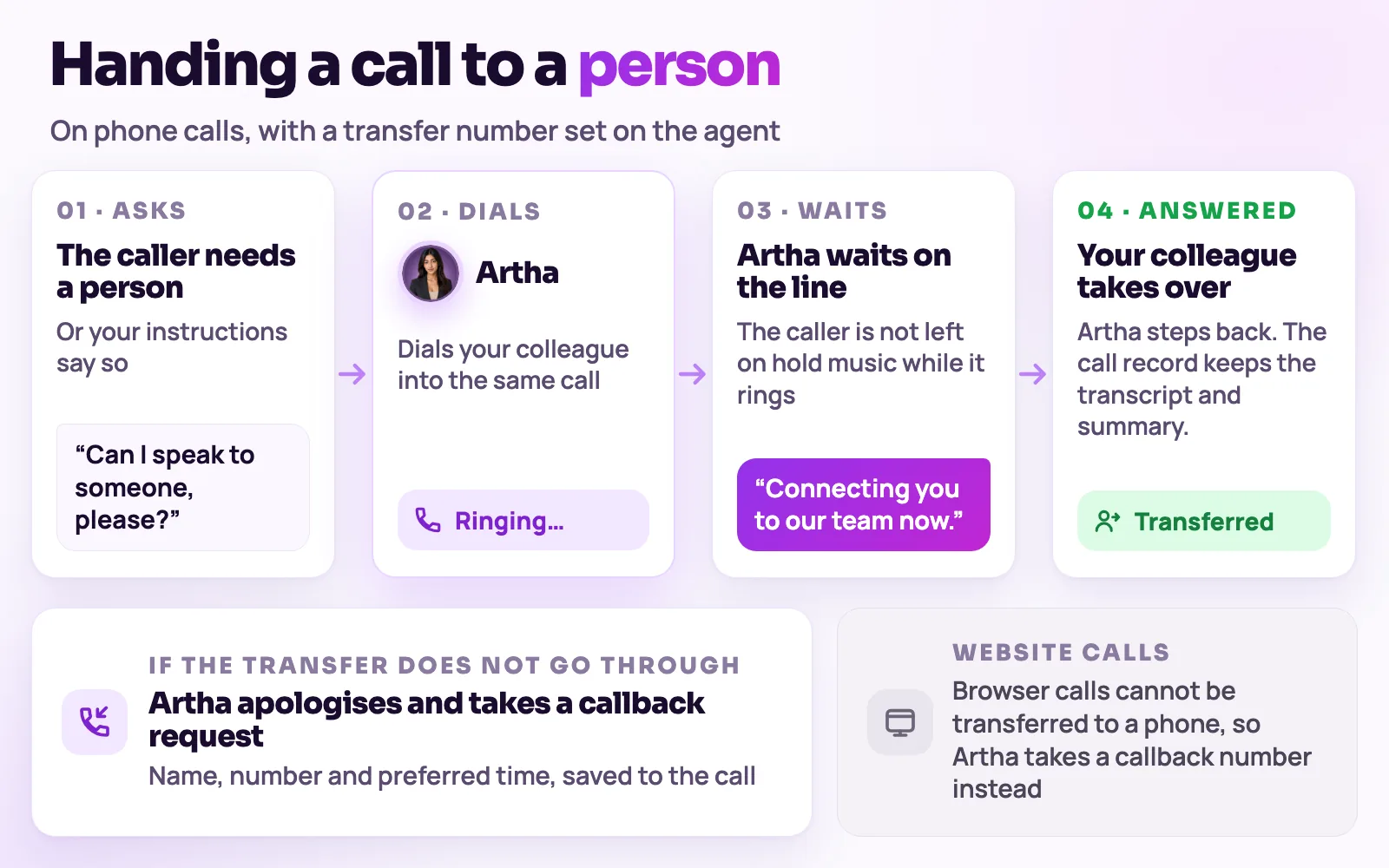
On phone calls the agent can dial in the colleague you set and stay on until they answer. Website calls take a callback request instead.
Functions and transferWhat if it does not know?
With strict mode on, it quotes your approved answers and says it will check with the team when something is not covered, rather than guessing.
Knowledge baseStill deciding? Ask Artha yourself.
- No signup needed
- 5 free calls
- 130+ languages
Questions, answered.
The things people ask us most. If yours isn’t here, talk to us and a person will reply.
Ask us directlyAn AI voice agent holds a spoken conversation on a phone or website call: it understands what the caller says, answers from approved information and takes actions such as booking. An IVR only plays a menu and routes on keypresses. A chatbot does similar work to a voice agent, but in text, so it cannot answer your phone line.
Not quite. An IVR routes - it collects a keypress and sends the caller somewhere. Artha holds a conversation, answers from your knowledge base, captures details, and books appointments without transferring anyone. When it is used in place of a menu, people call it an AI IVR.
For routing a few departments in one language, a menu IVR is cheap and fine. Once callers ask questions, want bookings, speak several languages or call after hours, a voice agent resolves more calls without a transfer. Many teams keep a person for sensitive or high-value calls.
Usually not, and we don’t recommend framing it that way. It absorbs the repetitive, high-volume calls - status checks, timings, qualification, reminders - so your team spends their day on the calls that genuinely need a person.
It transfers the call to a colleague if you have set a transfer number, or records a callback request. It is configured not to invent an answer it does not have.
Not necessarily. An existing number from a compatible provider can be connected once we confirm the setup, or you can use a new one. The website call widget needs no phone number at all.
Put an AI agent on every call.
Try Artha live in your browser, or book a walkthrough with our team.
- No signup needed
- 5 free calls
- 130+ languages