
Vistrow Voice vs Sarvam AI
A practical comparison for teams evaluating speech and language AI and AI voice agents for real customer calls.
- No signup needed
- Free to try
- 130+ languages
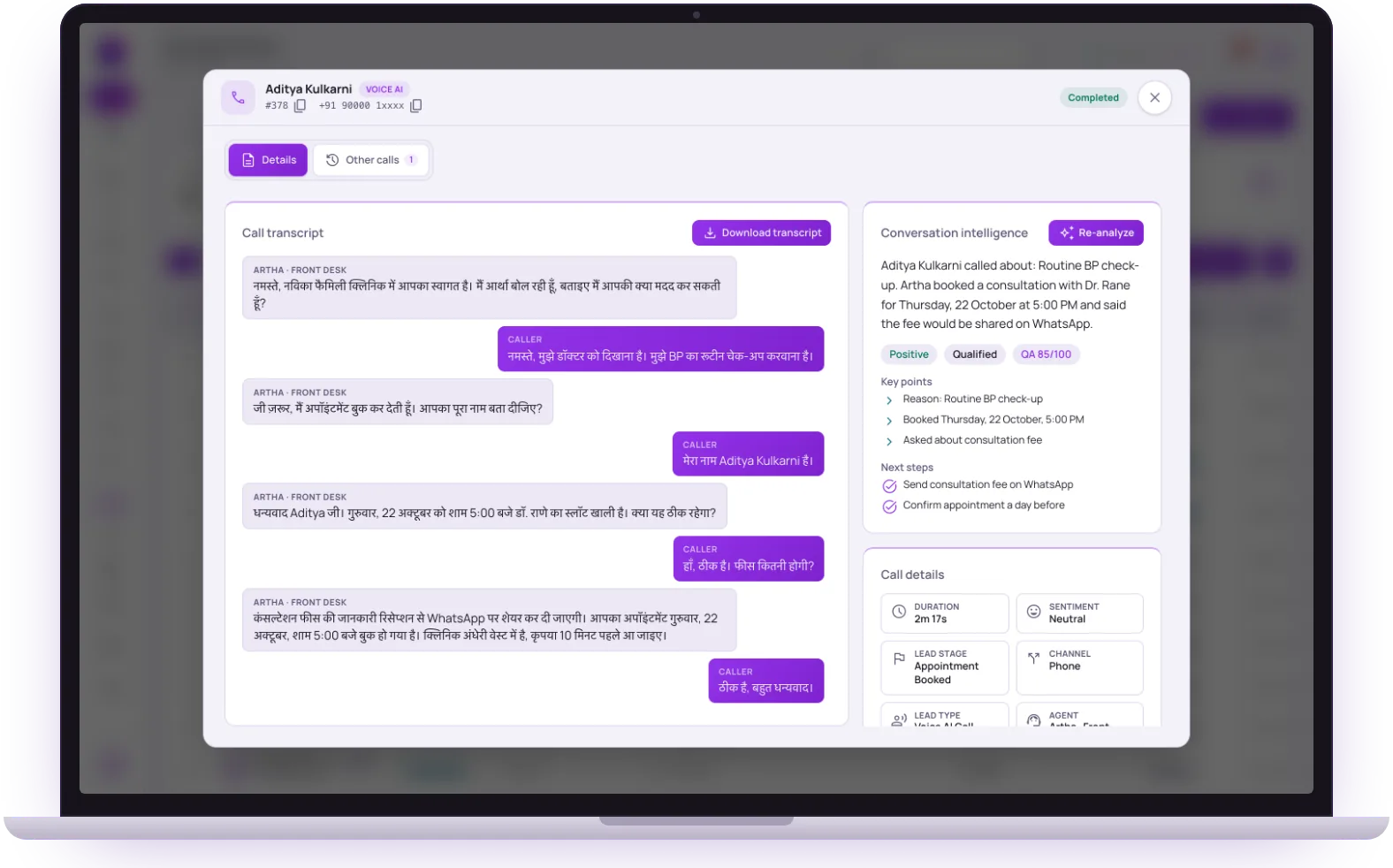 Call answered by ArthaTranscript and summary saved
When Sarvam AI fits
Engineering teams that want to build directly on Indian-language AI models, speech APIs, or agent infrastructure.
The tradeoff
Building directly can be powerful, but you still own product UX, call logs, CRM sync, billing, monitoring, tenant controls, and support workflows.
When Vistrow fits
Use this page if you are asking whether to build your own voice-agent stack or buy a finished calling platform.
Speech and language AI and Vistrow Voice, point by point.
| Decision point | Typical speech and language AI approach | Vistrow Voice |
|---|---|---|
| What you buy | Model, speech, and/or agent capabilities for builders. | Finished AI voice calling product for business users and operators. |
| Control | More low-level flexibility if your engineering team wants to assemble the stack. | More product defaults: dashboard, calls, recordings, transcripts, integrations, widget. |
| Time to launch | Depends on your engineering build. | Create an agent, connect knowledge/channel, test, and publish. |
| Cost control | Model/API costs depend on usage and architecture. | Plans with usage visibility in the dashboard. |
| Where it fits | Teams building proprietary voice infrastructure. | Teams that need working AI calls and CRM outcomes quickly. |
Match the tool to the job, not the brand.
Build on models
If you have engineers and want full control, building directly on speech and language models gives the most flexibility. You then own the product layer around them: call handling, recordings, logs, dashboards, billing and monitoring.
Buy a finished product
If the goal is working calls and CRM-ready records without a long build, a finished voice-agent product is the shorter path. You accept its defaults in return for speed.
Provider or product
These are not always rivals. A product can use model providers underneath, so ask any vendor which speech and language components sit behind the agent and how they are chosen per language.
The parts of a call it handles for you.
Languages
More than 130 languages, including 10 Indian languages and Hinglish, switching with the caller mid-call.
See the languagesPhone and website
Inbound phone calls through a connected number, plus a call widget that talks to website visitors in the browser.
The website widgetApproved answers
A knowledge base with strict mode, so the agent quotes your material instead of improvising.
The knowledge baseA finished record
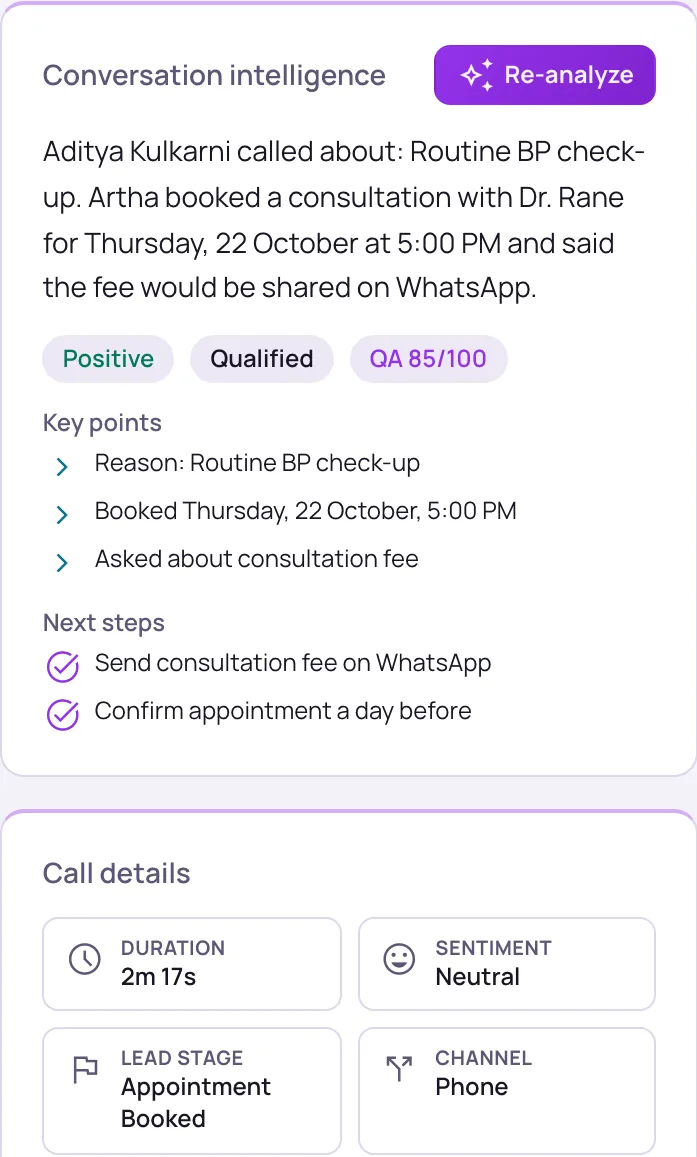
Transcript, summary, captured lead fields, optional recording and CRM or webhook delivery status for every call.
Integrations
Hear it on a real call before you decide.
Artha answers in your language, works on your number and your website, and leaves a record of every call.
Consent and recording, your call
Require spoken consent, switch recording on or off and set how long records are kept.
130+ languages
Hindi, Hinglish and 9 other Indian languages included. The agent follows the caller.
Phone and website
The same agent can answer your number and the call button on your site.
Every call logged
A transcript for every call, plus the lead fields captured and the audio if recording is on.
Ask these before you shortlist, including us.
Which parts of the stack do you operate for me: telephony, speech recognition, language model, voice, logs?
Which Indian languages and mixed-language patterns have been tested on live phone audio?
How is latency measured, and can I test it on my own network and numbers?
What records and exports exist for every call, and can I audit them?
What would my team have to build or maintain after launch?
Run the same real-call test before choosing.
First response latency
Interruption handling
Indian names and numbers
CRM payload quality
Real-call scorecard
Run the same real call on every tool you are testing, and check each row
- Languages on real callsYour callers’ language, names and numbers, and a switch mid-call
- SpeedThe pause after the caller stops, on a phone line, not a demo page
- HandoffsA transfer to a person, with the caller’s details passed on
- CRM outputThe right fields, summary and recording in your CRM after the call
- ControlsApproved answers, calling hours and limits you can set yourself
Try it next to what you use today.
Moving to an AI voice agent does not need a cut-over. Run it alongside your current setup on one narrow slice of calls, and keep the old path as fallback until the transcripts convince you.
- Step 1: Write a short spec of the calls you want handled, the languages and the record your team needs afterwards.
- Step 2: Estimate honestly what an in-house build would need: telephony, orchestration, a dashboard, call records, monitoring.
- Step 3: Run the same 20 test calls on a prototype and on a ready product, in your languages, on a phone and in a browser.
- Step 4: Compare time to a working pilot, caller experience and the maintenance each route leaves with your team.
The questions buyers ask first.
What does it cost?
Usage is measured in minutes of conversation, and the voice and model you choose change how quickly minutes are used. Telephony is billed separately by the provider you connect.
How pricing worksHow much setup is it?
No code. Set the persona, prompt, voice and language, test it in the browser, then publish. Later changes apply from the next call.
Create an agentCan a person take over?
On phone calls the agent can dial in the colleague you set and stay on until they answer. Website calls take a callback request instead.
Functions and transferWhat if it does not know?
With strict mode on, it quotes your approved answers and says it will check with the team when something is not covered, rather than guessing.
Knowledge baseStill deciding? Ask Artha yourself.
- No signup needed
- Free to try
- 130+ languages
Questions, answered.
The things people ask us most. If yours isn’t here, talk to us and a person will reply.
Ask us directlyIt can be either depending on your architecture. Some teams evaluate model providers while also evaluating full products like Vistrow Voice.
Choose Vistrow if you want the product layer already handled: agent setup, widget, call history, transcripts, CRM status, analytics, billing, and tenant controls.
Yes. Test phone and web calls with your target language, network, voice, STT, TTS, and LLM combination before choosing.
When voice is core to your own product, when you need deep control over every component, or when you already have a platform team that will maintain the system.
An agent builder, a knowledge base with strict mode, phone and website channels, call transcripts and recordings, a Testing Lab, and CRM and webhook delivery. See the product pages for each.
It speaks more than 130 languages, including ten Indian languages and English, including mixed Hindi-English speech, and keeps the same voice when the caller switches language. The languages page lists each one.
Related to Sarvam AI comparisons
Compare Sarvam AI with a live Vistrow call.
Test the voice, latency, transcript, and CRM-ready outcome before you decide.
- No signup needed
- Free to try
- 130+ languages