
Vistrow Voice vs Knowlarity
A practical comparison for teams evaluating cloud telephony and AI voice agents for real customer calls.
- No signup needed
- Free to try
- 130+ languages
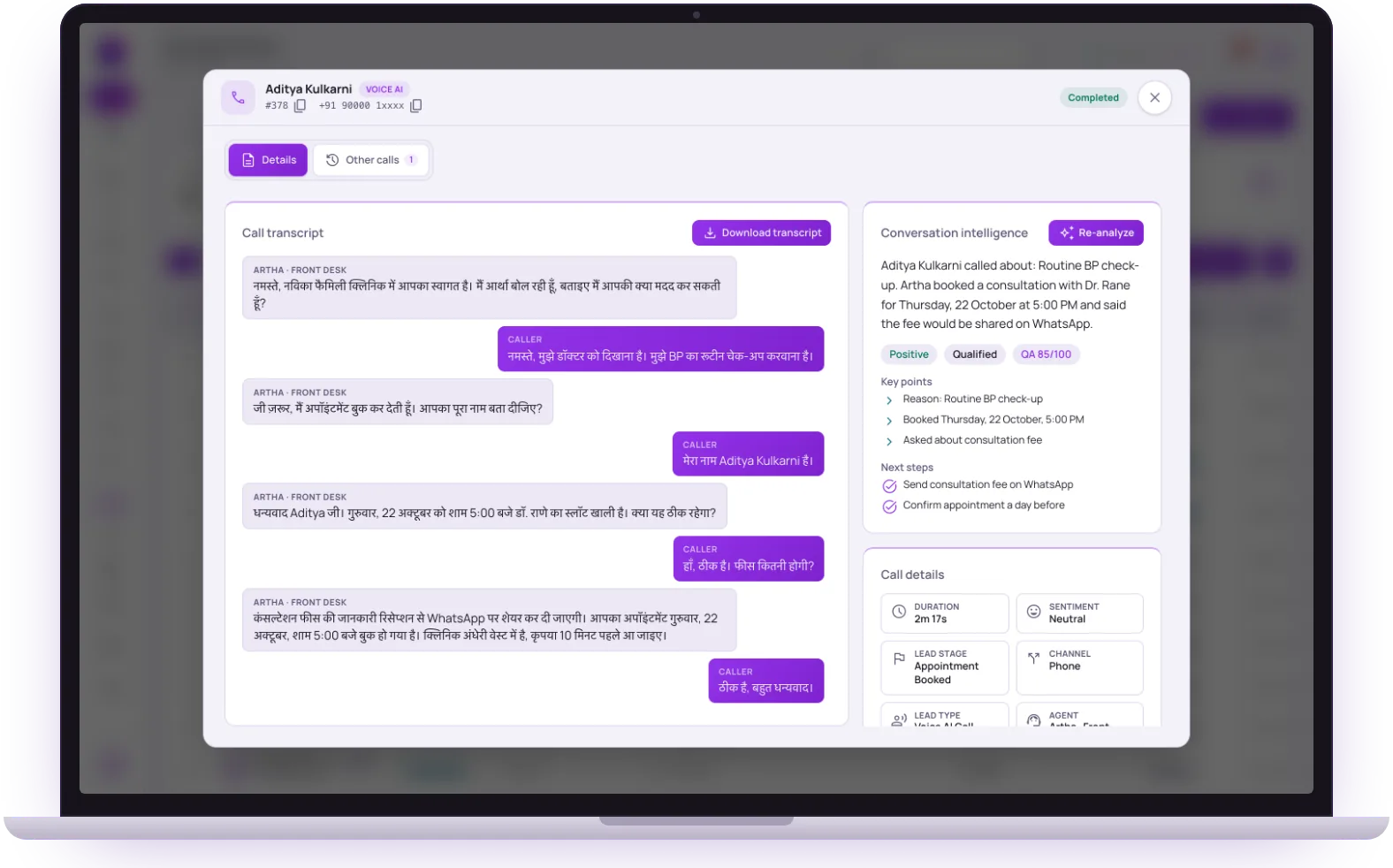 Call answered by ArthaTranscript and summary saved
When Knowlarity fits
Businesses looking for virtual numbers, IVR, call tracking, and cloud telephony workflows.
The tradeoff
Conversation intelligence and autonomous qualification may need additional AI tooling depending on your setup.
When Vistrow fits
Useful if your team is asking whether to modernize a call center stack or deploy a voice agent for repetitive calls.
Cloud telephony and Vistrow Voice, point by point.
| Decision point | Typical cloud telephony approach | Vistrow Voice |
|---|---|---|
| Core use case | Business calling, IVR, tracking, and routing. | AI-led inbound, outbound, and web conversations. |
| Caller experience | Structured call flows and routing logic. | Natural spoken conversation with knowledge-grounded answers. |
| Languages | Depends on the call-flow/agent setup. | More than 130 languages, including Hindi, English and 9 other Indian languages, with a default language per agent and mid-call switching. |
| CRM output | Depends on integration configuration. | Lead fields, transcript, call outcome, and recording link are prepared for CRM sync. |
| Where it fits | Telephony-first teams. | Teams that want the AI agent to do the first conversation. |
Match the tool to the job, not the brand.
Cloud calling and IVR are enough
If callers only need routing to a few departments, in one or two languages, a cloud telephony menu is simple and familiar. An AI agent adds little when nothing needs to be understood.
Callers ask questions or book
If callers describe a need, ask about timings or availability, or want an appointment, a conversational agent can resolve many of these calls without a transfer, using your knowledge base.
Modernising in stages
You do not have to replace a call stack in one move. Start with one line or an after-hours window, keep the existing menu as fallback, and widen only after the transcripts look right.
The parts of a call it handles for you.
Languages
More than 130 languages, including 10 Indian languages and Hinglish, switching with the caller mid-call.
See the languagesPhone and website
Inbound phone calls through a connected number, plus a call widget that talks to website visitors in the browser.
The website widgetApproved answers
A knowledge base with strict mode, so the agent quotes your material instead of improvising.
The knowledge baseA finished record
Transcript, summary, captured lead fields, optional recording and CRM or webhook delivery status for every call.
Integrations
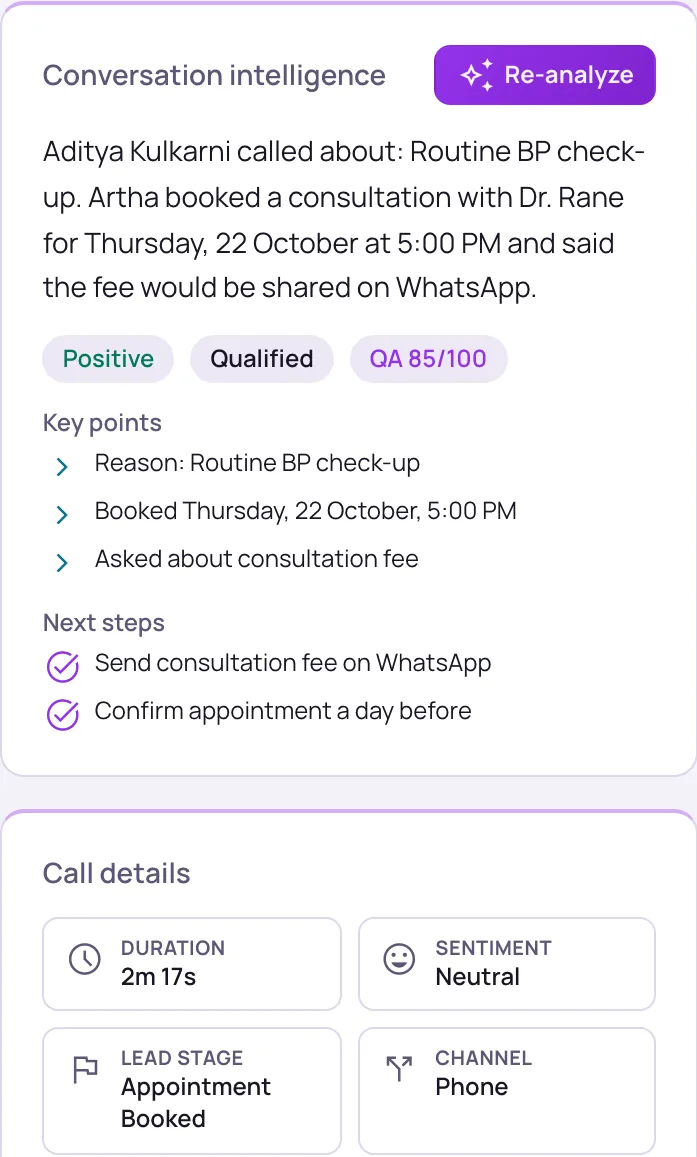
Hear it on a real call before you decide.
Artha answers in your language, works on your number and your website, and leaves a record of every call.
Consent and recording, your call
Require spoken consent, switch recording on or off and set how long records are kept.
130+ languages
Hindi, Hinglish and 9 other Indian languages included. The agent follows the caller.
Phone and website
The same agent can answer your number and the call button on your site.
Every call logged
A transcript for every call, plus the lead fields captured and the audio if recording is on.
Ask these before you shortlist, including us.
Is the caller asked to press keys, or can they say what they need in their own language?
How are callers who switch between languages mid-call handled?
Can the system book appointments or take a callback request on the call itself?
What is saved after each call: audio, transcript, captured fields, outcome?
How do you update the answers when a price list, timing or policy changes?
Run the same real-call test before choosing.
First response latency
Interruption handling
Indian names and numbers
CRM payload quality
Real-call scorecard
Run the same real call on every tool you are testing, and check each row
- Languages on real callsYour callers’ language, names and numbers, and a switch mid-call
- SpeedThe pause after the caller stops, on a phone line, not a demo page
- HandoffsA transfer to a person, with the caller’s details passed on
- CRM outputThe right fields, summary and recording in your CRM after the call
- ControlsApproved answers, calling hours and limits you can set yourself
Try it next to what you use today.
Moving to an AI voice agent does not need a cut-over. Run it alongside your current setup on one narrow slice of calls, and keep the old path as fallback until the transcripts convince you.
- Step 1: List the five reasons people call most and note what your team says on each one.
- Step 2: Turn those answers into a knowledge base and a short agent prompt, then test them in the browser before any number is involved.
- Step 3: Send a small share of real calls, or after-hours calls only, to the agent while the existing flow keeps handling the rest.
- Step 4: Review transcripts and transfers weekly, then decide which lines can move.
The questions buyers ask first.
What does it cost?
Usage is measured in minutes of conversation, and the voice and model you choose change how quickly minutes are used. Telephony is billed separately by the provider you connect.
How pricing worksHow much setup is it?
No code. Set the persona, prompt, voice and language, test it in the browser, then publish. Later changes apply from the next call.
Create an agentCan a person take over?
On phone calls the agent can dial in the colleague you set and stay on until they answer. Website calls take a callback request instead.
Functions and transferWhat if it does not know?
With strict mode on, it quotes your approved answers and says it will check with the team when something is not covered, rather than guessing.
Knowledge baseStill deciding? Ask Artha yourself.
- No signup needed
- Free to try
- 130+ languages
Questions, answered.
The things people ask us most. If yours isn’t here, talk to us and a person will reply.
Ask us directlyThe key difference is buying intent: cloud telephony manages calls; Vistrow Voice manages AI conversations on calls.
Yes. The same product supports phone calls and a browser voice widget, so website visitors can speak without dialing a number.
Usually yes. The right architecture depends on your current number provider, routing, and compliance setup.
No. An IVR routes by keypress. A voice agent understands speech and answers or completes a task. When used to replace a menu, it is often called an AI IVR; see the dedicated page for the call flow.
On phone calls, yes: set a transfer number and the agent can dial a colleague into the call, or take a callback request when nobody is free. Web calls cannot be transferred to a phone.
Measure how many calls were resolved without a transfer, how accurate the captured details were, how callers reacted, and how many hand-offs arrived with useful context.
Related to Knowlarity comparisons
Compare Knowlarity with a live Vistrow call.
Test the voice, latency, transcript, and CRM-ready outcome before you decide.
- No signup needed
- Free to try
- 130+ languages